
Interoutes at Posidonia 2026 with NAPA
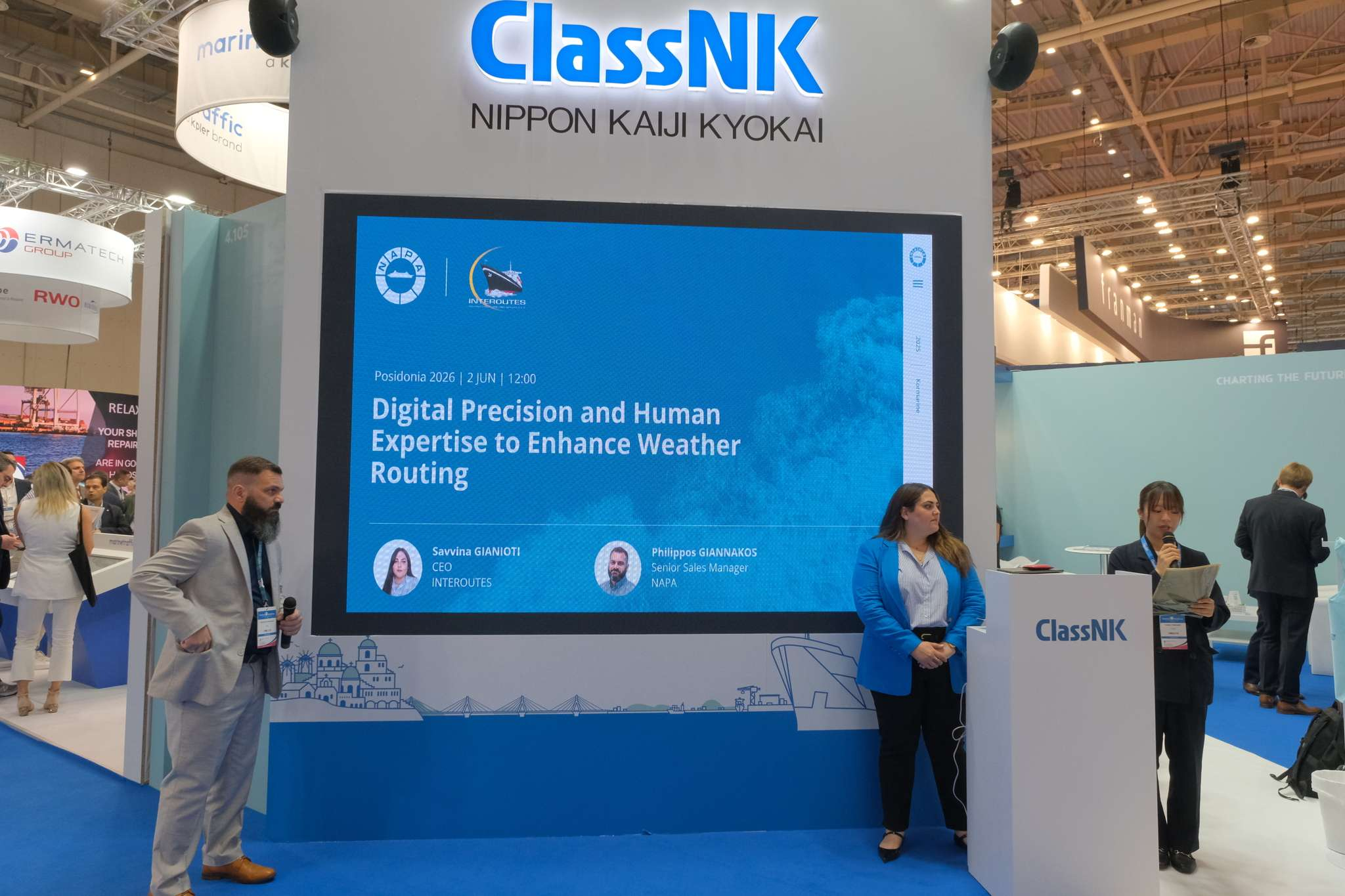
Athens, Greece - 1 June 2026
Posidonia has always been more than an exhibition. For the maritime community, it is one of those rare meeting points where technology, operations, regulation, commercial pressure and real seagoing experience all enter the same conversation. The 2026 edition took place from 1 to 5 June at the Athens Metropolitan Expo, bringing the global shipping community back to Greece at a moment when fleet performance, digitalization, decarbonization and operational efficiency are no longer future ideas, but daily management realities.
For Interoutes, this year’s presence at Posidonia carried a special meaning. We were there as partners of NAPA, joining their stand talk program at the NAPA and ClassNK booth, where NAPA invited experts and partners to deliver short presentations on ship performance monitoring, voyage optimization, wind assisted propulsion and emissions compliance. Within that setting, Interoutes joined NAPA for a shared presentation titled Digital Precision and Human Expertise to Enhance Weather Routing, delivered on 2 June at 12 noon by Savvina Gianioti, CEO of Interoutes, together with Philippos Giannakos, Senior Sales Manager at NAPA.
The title of the presentation captured exactly what we believe the next chapter of voyage planning must look like. Shipping does not need technology that removes people from the decision. It needs technology that makes good maritime judgment sharper, faster and easier to apply. Weather routing becomes truly valuable when digital precision supports human expertise, rather than trying to replace it.
That message was important because voyage planning in 2026 has become more demanding than ever. The presentation addressed a reality that many owners, operators and masters already understand. Forecasts alone are not enough for safe voyage commitment. Crews are overstretched and need tools that simplify decisions instead of adding complexity. Voyage planning has become too layered for any single tool to solve everything alone. Connectivity can still limit real time decision making. Digital tools also need proven outcomes before they earn the trust of crews and shore management.
This is where the Interoutes and NAPA partnership becomes especially relevant. NAPA brings digital infrastructure, vessel performance insight and voyage optimization capability, while Interoutes brings human centered weather routing, maritime judgment and hands on operational experience. In the joint presentation, we showed how expert route monitoring can combine technology with experienced mariners, delivering real time routing support fully integrated into NAPA Voyage Optimization. The goal is not to flood the bridge with data. The goal is to give masters and operators clearer route advice, frequent weather updates, route adjustments throughout the voyage and planning scenarios that can be understood before the vessel commits to them.
This approach fits the wider direction of the industry. NAPA’s own Posidonia 2026 page highlighted the growing importance of model backed performance insights, high frequency signal data, voyage optimization and emissions compliance, especially as EU ETS and FuelEU Maritime place more pressure on shipowners to move from data collection towards proactive performance management. Around Posidonia, the broader maritime conversation also reflected the same direction, with industry voices discussing digital transformation, smart shipping, vessel optimization, decarbonization and the need for practical technologies that work in real operating conditions.
During the stand talk, we also shared practical voyage examples showing the commercial value of combining expert monitoring with digital planning. One pre voyage comparison demonstrated how operators can evaluate expected ETA and voyage costs in advance by testing different speed and consumption scenarios. Another route comparison showed how an optimal route, assessed against forecasted weather and ocean current data, projected an arrival four days earlier and 160 metric tonnes less fuel than an alternative route using the same operational profile. Executed voyage cases also illustrated measurable savings, including one passage affected by adverse currents near South Africa and another voyage, to which Weather Routing Advice was requested shortly before sailing under expected extreme weather conditions.
For us, these examples were not just numbers. They were proof of a principle. The future of weather routing is not generic forecasting. It is human guided, vessel specific, continuously monitored voyage intelligence. A vessel does not need a beautiful chart that no one trusts. It needs routing advice that understands weather, currents, cargo, performance, fuel, emissions, ETA and the reality of command at sea.
Our presence at Posidonia 2026 as NAPA partners was therefore not only an opportunity to present a service. It was an opportunity to join a wider maritime conversation about how digital systems and experienced people can work together. The industry is moving towards more connected, data driven and emissions aware operations, but the bridge still needs clarity, the office still needs confidence and the vessel still needs human judgment behind every recommendation.
Interoutes was proud to stand beside NAPA and to speak with guests about a shared belief that has shaped our work for years. Technology is strongest when it respects the people who use it. Weather routing, voyage optimization and performance monitoring will keep evolving, but their purpose remains the same. They exist to help vessels sail safer, smarter and with better control over the commercial and environmental consequences of every voyage.
TO DOWNLOAD THE PRESENTATION CLICK HERE